Quinson · 04
Musée de Préhistoire des Gorges du Verdon
One of Europe’s largest prehistory museums, designed by architect Norman Foster, at the heart of the lower Gorges du Verdon.
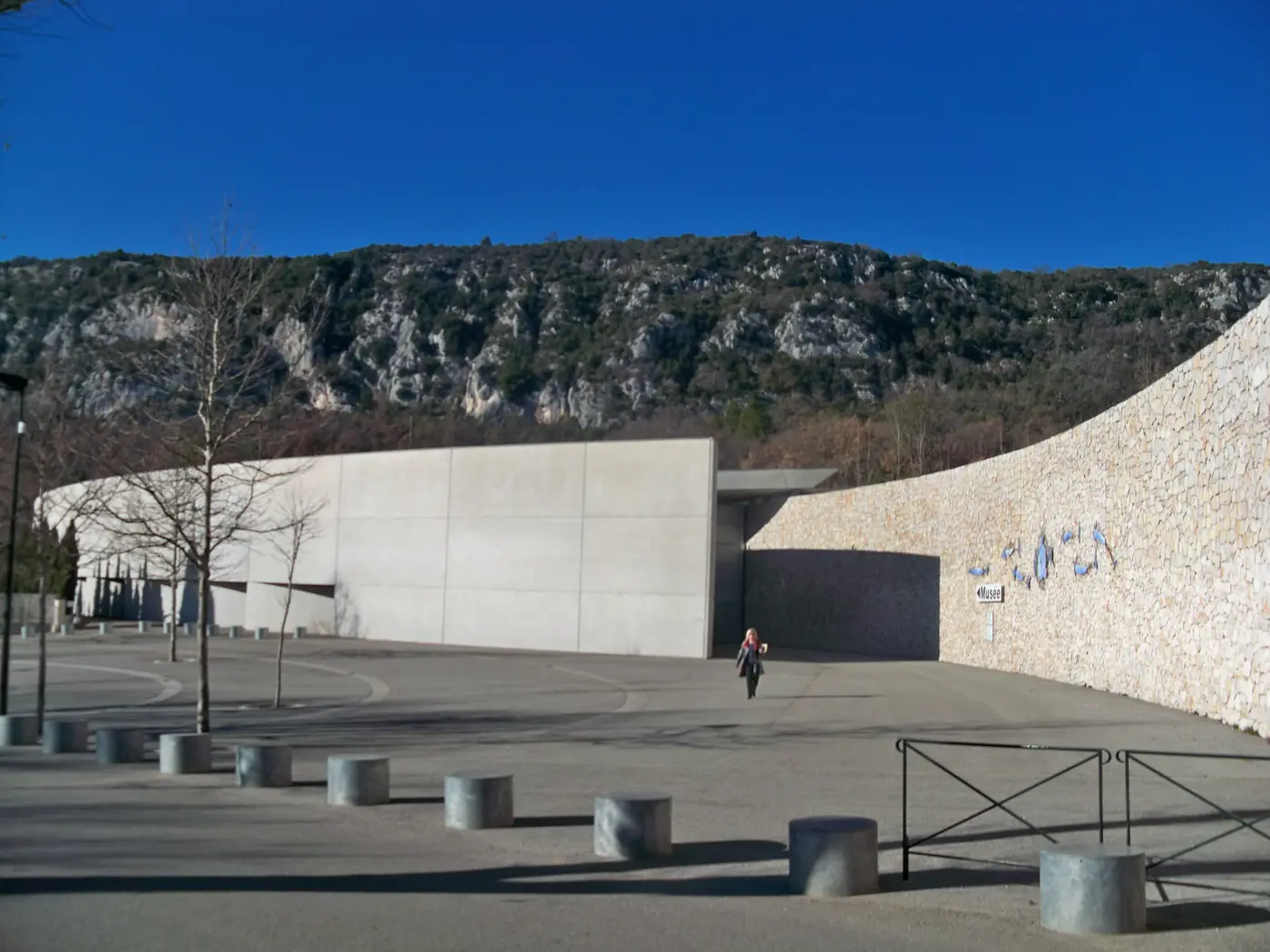
- A departmental museum of the Alpes-de-Haute-Provence, opened to the public in 2001 and awarded the “Musée de France” label (France’s official quality label for museums).
- A building by British architect Norman Foster (Foster + Partners), winner of a competition launched in 1992 together with museographer Bruno Chiambretto: an elongated shape around 120 m long that hugs the hillside, covering more than 4,000 m².
- Presented as one of the largest prehistory museums in Europe.
- It traces a million years of human history in Provence — from the first humans to the Roman conquest — drawing on excavations at around sixty sites in the Verdon.
- The visit continues at two outdoor sites: the Baume Bonne cave (around 400,000 years of occupation) and an open-air reconstructed prehistoric village.
What you’ll see
- A permanent exhibition on “Prehistory in Provence”, from the origins of humankind to the Roman conquest, laid out in chronological order: a million-year journey through time.
- At the entrance, life-size reconstructions of prehistoric wildlife: mammoth, woolly rhinoceros, reindeer, giant deer (megaloceros) and sabre-toothed tiger.
- Life scenes (dioramas) featuring Homo erectus and Neanderthal man, a reconstruction of the Grotte des Soleils inside the museum, and objects from the sixty or so excavated sites.
- Collections covering the Palaeolithic, the Neolithic and the Bronze Age; an audio guide is available in several languages.
The Baume Bonne Cave
- A major archaeological site on the banks of the Verdon, occupied by humans for around 400,000 years — one of the oldest prehistoric sites in Europe, listed as a Historic Monument in 1992.
- Occupied successively by Homo erectus (numerous handaxes), the Neanderthals (Levallois flint-knapping) and then Homo sapiens; the earliest evidence of fire here dates back around 350,000 years.
- Excavated by the Bottet brothers (1946-1956), then under the direction of prehistorian Henry de Lumley until 1968, and finally by Claire Gaillard and Jean Gagnepain from 1988 onwards.
- A type of prehistoric tool, the “pointe de Quinson” (Quinson point), was defined based on this site.
- The cave can only be visited on a guided tour with a museum guide, around an hour’s walk along the Verdon.
The Prehistoric Village
- An open-air reconstructed village, featuring five dwellings from different eras and a dolmen.
- The dwellings are reconstructed after reference sites from prehistory: Olduvai-type stone circles, huts inspired by Terra Amata, Upper Palaeolithic tents, and Neolithic structures.
- Workshops and demonstrations are held there: lighting a fire without matches, archery, and spear-throwing with an atlatl (spear-thrower).
Why Quinson
- Quinson lies in the lower Gorges du Verdon, between Lake Sainte-Croix upstream and Lake Esparron, close to Lake Quinson.
- Upstream, the Baudinard gorges open out, home to the Baume Bonne cave.
- The Baume Bonne site offered ideal conditions for Palaeolithic groups: full south-facing exposure, proximity to water and raw materials, and a clear view over the plain for hunting.
- Around sixty prehistoric sites excavated around the Verdon justify the museum’s location here.
The museum is on the route de Montmeyan in Quinson (04500), at the entrance to the lower Gorges du Verdon. It’s reached by road from Moustiers-Sainte-Marie, Riez and Gréoux-les-Bains, and from Lake Sainte-Croix and Lake Esparron. The Baume Bonne cave can only be reached on foot from the museum, on a guided tour (around an hour’s walk).
Official museum website (opening hours & prices) ↗Frequently asked questions
Who designed the building?
British architect Norman Foster (Foster + Partners), winner of an architecture competition in 1992, working alongside museographer Bruno Chiambretto; the museum opened in 2001.
Can you visit the Baume Bonne cave?
Yes, but only on a guided tour with a museum guide. It’s reached on foot, around an hour’s walk from the museum, along the Verdon.
How much history does the museum cover?
Around a million years, from the first humans in Provence to the Roman conquest — hence its nickname “Mille millénaires” (a thousand millennia).
Is the museum open all year round?
It’s open for much of the year. As opening hours and prices vary by season, it’s best to check them on the official website, museeprehistoire.com, before you come.
Check for yourself
The sources this page relies on, one click away. We would rather you be able to contradict us than ask you to take our word for it.
- Musée de Préhistoire des Gorges du Verdon — site officielmuseeprehistoire.com
- Wikipédia — Musée de Préhistoire des gorges du Verdonfr.wikipedia.org
- Wikipédia — Grotte de la Baume-Bonnefr.wikipedia.org
- Hominidés — Musée de préhistoire de Quinsonhominides.com
- Alpes de Haute-Provence Tourisme — fiche du muséetourisme-alpes-haute-provence.com
5 of these 5 links responded during our last automated check, on 2026-08-22. A broken link is removed, never left in place.